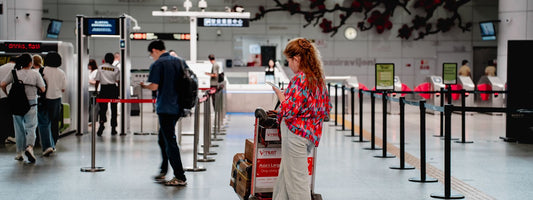
If you travel often, few things are as quietly satisfying as gliding through airport security while everyone around you juggles bins and yanks laptops out of bags. The secret isn't a trick—it's a TSA-friendly backpack and knowing exactly how it works.
Here's the complete picture, including the rules most blog posts get fuzzy on.
What "checkpoint-friendly" actually means
First, a myth to retire: the TSA does not certify or approve bags. There is no official "TSA-approved" backpack. What exists are published design guidelines the TSA released so manufacturers can build bags that let you leave your laptop inside during X-ray screening. "Checkpoint friendly" means the bag was designed to meet those guidelines—nothing more.
To qualify, the laptop-only compartment must:
- Unfold to lie completely flat on the X-ray belt, with nothing above or below it.
- Contain nothing but the laptop—no chargers, cables or papers.
- Have no pockets on the inside or outside of that section.
- Include no metal snaps, zippers or buckles that would obscure the X-ray image.
The design that achieves this is the 180° butterfly opening: the bag splits into two halves and the laptop side folds flat like an open book, giving the scanner a clean view.

Why it saves you real time
At a standard checkpoint, laptops normally come out into their own bin. With a compliant lay-flat bag, you unzip, fold the laptop wing flat on the belt, send it through, then zip up and walk. Across frequent trips that's a meaningful, stress-reducing difference—especially when you're sprinting a connection.
One honest caveat
A checkpoint-friendly bag improves your odds; it doesn't guarantee them. Officers can still ask you to remove the laptop if the X-ray image isn't clear, if you're selected for extra screening, or simply at their discretion—and rules vary by airport. Treat it as a strong convenience, not an ironclad rule, and always follow the officer's instructions.
What makes a great travel backpack beyond the lay-flat trick
The TSA feature is the headline, but a genuinely good travel backpack pairs it with carry-on-friendly dimensions, a trolley/luggage pass-through strap, a waterproof shell with durable (YKK-style) zippers, smart compartments (a wet/dry pocket and a quick-access pocket for liquids and electronics), and real comfort for long terminal walks.
The Bange Aerox 2517 is built around this exact use case: a 180° full-open laptop compartment that fits up to 17\", a waterproof coated-Oxford shell with YKK zippers, an Air Bag Belt carry system, and a built-in USB port. For extra room on the way home, the expandable Zenith 22005 grows from roughly 25L to 35L.
How to pack so security actually goes smoothly

- Keep the laptop section clean—only the laptop, or you defeat the lay-flat rule.
- Stage your liquids in an outer pocket you can grab in one motion.
- Corral electronics—tablets, power banks and cables in one pocket.
- Don't overstuff; the laptop wing has to open fully flat.
- Empty your water bottle before the line and refill after.
Who should prioritize a TSA-friendly backpack?
Frequent flyers, business travelers and digital nomads get the most value—anyone who passes through security often enough that small time savings add up. If you fly once or twice a year, it's a nice-to-have, and you can simply pull your laptop out like everyone else.
Frequently asked questions
Is any backpack officially "TSA-approved"?
No. The TSA publishes guidelines but doesn't certify bags. "Checkpoint friendly" means the maker followed those guidelines.
Will I definitely keep my laptop in the bag?
Usually, if the bag lies flat and the image is clear—but officers can still ask you to remove it at their discretion.
What is a 180° laptop compartment?
A design where the bag opens into two flat halves so the laptop side lies flat on the belt with nothing above or below it.
The bottom line
A TSA-friendly backpack with a true 180° lay-flat laptop compartment is one of the highest-value upgrades a frequent traveler can make. Understand the rules, pack to honor them, and you'll spend less time at the belt and more time at the gate.
See Bange's travel-ready, lay-flat backpacks built for the airport and everything after it.
Previous
Do Anti-Theft Backpacks Actually Work? An Honest Guide
Next
Backpack vs Sling vs Messenger Bag: Which Should You Carry?