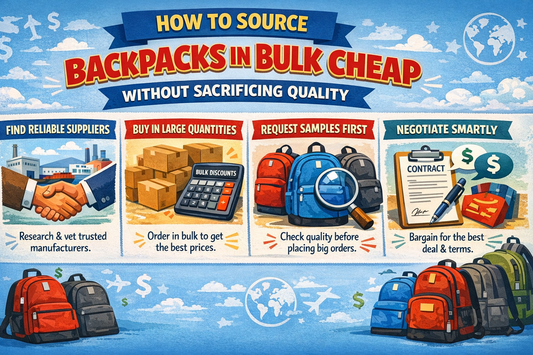
Wholesale Backpack Suppliers: What Retailers Need to Know in 2026
The wholesale backpack supplier landscape in 2026 has fundamentally transformed. Buyers are no longer choosing suppliers based primarily on price. Quality, reliability, sustainability, customization capability, and strategic partnerships have become the real differentiators. For retailers, understanding this new supplier landscape—where suppliers operate, which ones deliver exceptional value, what trends are driving the market, and how to negotiate strategically—is essential to sourcing success. This comprehensive guide provides everything retailers need to know about wholesale backpack suppliers in 2026 and beyond.
The 2026 Wholesale Backpack Supplier Landscape
Market Size and Growth
The global backpack market continues expanding, driven by increased travel, remote work culture, outdoor recreation, and student purchases. Retailers entering the wholesale market face both opportunity and competition.
$15.2B
Global backpack market size
7.3%
Average annual growth rate
40%+
Retailers buying wholesale
60%+
Quality over price priority
Geographic Supplier Distribution
| Region | Primary Suppliers | Characteristics | Lead Time | Price Range |
|---|---|---|---|---|
| Asia (China, Vietnam, India) | Direct manufacturers, Major distributors | High volume, variable quality, lowest cost | 8-16 weeks | $6-12/unit |
| Europe | Premium manufacturers, Quality-focused brands | Excellent quality, sustainability focus, higher cost | 6-10 weeks | $18-35/unit |
| USA/North America | Regional distributors, Premium brands (Bange, others) | Fast delivery, reliable service, highest cost | 2-6 weeks | $15-30/unit |
| Hybrid/Global | International distributors, E-commerce platforms | Balanced cost, quality, and speed | 4-8 weeks | $10-20/unit |
Key Insight: 2026 suppliers increasingly offer global reach—manufacturing in Asia but operating distribution centers in North America/Europe. This hybrid model provides cost advantages with speed/reliability benefits. Retailers should evaluate this emerging category.
2026 Industry Trends Reshaping the Supplier Landscape
Trend #1: Quality-First Movement
Retailers Prioritize Quality Over Lowest Price
In 2026, the race to the bottom on pricing has shifted. Retailers increasingly understand that cheap backpacks generate returns, damage reputation, and waste capital. Quality-focused suppliers like Bange that invest in durable materials, rigorous testing, and customer satisfaction are gaining market share.
Impact: Suppliers emphasizing quality control, material sourcing, and durability outcompete commodity suppliers. A supplier costing 20% more but delivering zero defects is more profitable than a cheap supplier with 15% defect rate.
Trend #2: Sustainability as Standard, Not Premium
Eco-Friendly Materials and Ethical Manufacturing
Sustainability has moved from nice-to-have to essential. Retailers increasingly demand suppliers using recycled materials, sustainable manufacturing, and ethical labor practices. Customers expect this; suppliers providing it gain competitive advantage.
Impact: Suppliers unable to articulate sustainability practices lose business. Premium suppliers now incorporate sustainability as core value, not premium feature. Expect sustainability to become baseline expectation by 2027-2028.
Trend #3: Customization at Scale
Private-Label and Custom Branding Democratized
Customization used to require 1,000+ unit minimums. In 2026, leading suppliers offer meaningful customization at 200-300 unit levels. This enables smaller retailers to differentiate through branded products.
Impact: Retailers can now compete on brand differentiation, not just price. Custom backpacks command 25-50% premiums. Suppliers offering accessible customization create higher-margin opportunities for retail partners.
Trend #4: Technology Integration
Smart Features, USB Ports, RFID Protection Standard
Today's backpacks increasingly include tech integration—built-in USB charging, RFID-blocking, water-resistant coatings, organized tech compartments. Suppliers offering these features appeal to modern consumers.
Impact: Basic backpacks face downward pricing pressure. Tech-integrated backpacks command premiums. Forward-thinking suppliers invest in tech-friendly designs; others get commoditized.
Trend #5: Supply Chain Resilience
Retailers Demand Backup Suppliers and Diversification
Post-pandemic, retailers learned over-reliance on single suppliers creates catastrophic risk. Leading retailers now maintain 2-3 supplier relationships. Suppliers offering reliability and consistency gain loyalty; unreliable suppliers lose business.
Impact: Reliability becomes competitive advantage. Suppliers consistently meeting deadlines, maintaining quality, and communicating clearly become preferred partners. Flaky suppliers get replaced.
Pricing Strategies in 2026
Volume-Based Pricing Tiers
Wholesale pricing in 2026 follows clear volume tiers, but with variation based on supplier type and product complexity.
💰 Tier 1: Starter Orders (100-200 units)
Cost per unit: $18-25 | Supplier type: Regional distributors, premium brands | Lead time: 2-4 weeks
Ideal for testing market, proving demand, building supplier relationship. Higher per-unit cost but fast delivery and low risk.
💰 Tier 2: Growth Orders (250-500 units)
Cost per unit: $14-18 | Supplier type: International distributors, quality manufacturers | Lead time: 4-8 weeks
Sweet spot pricing. Enough volume to negotiate discounts without large inventory risk. Most retailers operate at this tier.
💰 Tier 3: Scaling Orders (500-1,000 units)
Cost per unit: $10-15 | Supplier type: Direct manufacturers, major distributors | Lead time: 6-10 weeks
Significant volume discounts. Requires capital and inventory management. Used by growing retailers expanding locations.
💰 Tier 4: Enterprise Orders (1,000+ units)
Cost per unit: $6-12 | Supplier type: Direct manufacturers, OEM suppliers | Lead time: 8-16 weeks
Lowest per-unit costs but requires significant planning, capital, and inventory management. Used by large retailers and distributors.
Top Wholesale Backpack Suppliers by Category in 2026
Premium Quality & Reliability Category
🏆 Bange (Quality Leader)
Specialty: Professional, travel, and tech-integrated backpacks
Price Range: $18-28 wholesale
Lead Time: 3-6 weeks
Why retailers choose Bange: Exceptional build quality, innovative features, rigorous quality control, responsive customer service. Bange backpacks consistently receive positive customer reviews. Their emphasis on durability and functionality justifies premium pricing.
Best for: Retailers seeking premium positioning, quality-conscious customers, corporate gifting, professional/business backpack segment.
Customization: Moderate—private labeling available at 500+ unit levels. Embroidery and color options available.
Standout Feature: Exclusive designs not available through other wholesale suppliers create differentiation opportunity.
Value & Accessibility Category
📦 International Distributors (Alibaba-based)
Specialty: Wide variety, budget-friendly options, custom manufacturing
Price Range: $8-18 wholesale
Lead Time: 8-12 weeks
Why retailers choose them: Lowest pricing, extensive product selection, customization flexibility, willingness to work with new suppliers.
Best for: Budget-focused retailers, high-volume orders, experimental/trending products, price-competitive market segments.
Customization: Extensive—these suppliers specialize in custom manufacturing. Color options, design modifications, branded packaging all standard.
Challenge: Quality variability, communication delays, longer lead times. Requires thorough vetting.
Speed & Convenience Category
⚡ Regional Distributors (Domestic)
Specialty: Fast delivery, responsive service, moderate pricing
Price Range: $14-22 wholesale
Lead Time: 2-4 weeks (often next-day availability)
Why retailers choose them: Speed, responsiveness, ease of communication, problem-solving agility, relationship-focused service.
Best for: Retailers needing fast restocks, seasonal peaks, urgent orders, customer relationship priority.
Customization: Limited—focus is on quick delivery of standard products. Custom orders may not be available.
Advantage: Real people to call, local relationships, problem resolution at local level.
Strategic Supplier Partnership Framework
Multi-Supplier Strategy (Recommended Approach)
Leading retailers in 2026 don't rely on single suppliers. They maintain strategic relationships with 2-3 suppliers serving different purposes:
Primary Supplier
Role: Main relationship for bulk orders
Criteria: Best overall value, proven quality, reliable communication
Volume: 60-70% of purchases
Example: Premium brand like Bange for core product line
Secondary Supplier
Role: Backup for volume surges, product diversity
Criteria: Different product specialty, complementary strengths
Volume: 20-30% of purchases
Example: International distributor for trendy/custom products
Tertiary Supplier
Role: Emergency restocks, specialty needs
Criteria: Fast delivery, specific capabilities, problem-solving strength
Volume: 5-10% of purchases
Example: Regional distributor for rush orders
✓ Strategic Advantage: Multi-supplier approach provides redundancy, prevents supply chain risk, enables product diversification, and improves negotiation leverage. When suppliers know you have alternatives, they're more responsive and competitive.
Supplier Selection Checklist for 2026
Verify years in business and business registration (minimum 3-5 years recommended)
Request and verify customer references (call at least 3)
Evaluate quality control process and request defect rate documentation
Get detailed, itemized quotes (not just unit price)
Verify lead times and ask what happens if they miss deadline
Test communication responsiveness before committing
Request product samples and inspect thoroughly
Understand warranty, return, and defect policies in writing
Evaluate sustainability practices (materials, manufacturing ethics)
Review customization capabilities and ask for portfolio examples
Common Supplier Pitfalls to Avoid
Pitfall #1: Choosing Based on Price Alone
Problem: Cheapest supplier often isn't best value. Low-cost suppliers frequently miss deadlines, deliver poor quality, and provide terrible service.
Solution: Evaluate true value: quality + reliability + service + price. Pay 10-15% more for suppliers that deliver consistently.
Pitfall #2: Overcommitting Without Testing
Problem: Ordering 1,000 units from unproven supplier. If relationship fails, you're stuck with inventory.
Solution: Start with small orders (200-300 units). Prove reliability before scaling commitments.
Pitfall #3: Ignoring Hidden Costs
Problem: "$12 per unit" doesn't include shipping, duties, inspection, or packaging. True cost is 25-40% higher.
Solution: Request itemized quotes with all costs. Calculate true landed cost before committing.
Pitfall #4: Failing to Diversify Suppliers
Problem: Single supplier controls your supply chain. If they fail, your business suffers.
Solution: Maintain 2-3 supplier relationships. Spread risk and gain negotiation leverage.
Pitfall #5: Not Verifying References
Problem: Trusting supplier's claims without independent verification. Supplier stories don't match reality.
Solution: Call at least 3 customer references. Ask specific questions about quality, reliability, and service.
The Future of Wholesale Backpack Sourcing (2026-2028)
What's Coming Next
On-Demand Manufacturing: 3D printing and on-demand production will enable ultra-low MOQs. Retailers will order exactly what they need when they need it, eliminating inventory waste.
AI-Powered Customization: Suppliers will offer AI-designed customizations. Upload your brand vision; AI recommends design options. Faster, cheaper customization at scale.
Sustainability Standards Mandatory: Eco-friendly materials and ethical manufacturing will become baseline requirements, not premium features. Suppliers unable to meet sustainability standards will become uncompetitive.
Hyperlocal Production: Manufacturing will shift closer to markets (local production instead of long-distance shipping). Shorter lead times, lower environmental impact, faster customization.
Direct-to-Retailer Relationships: Middlemen distributors will disappear. Retailers will work directly with manufacturers through technology platforms, eliminating markup layers.
Key Takeaways: What Every Retailer Should Know
- Quality is competitive advantage: Suppliers emphasizing quality, durability, and customer satisfaction outperform commodity suppliers. Pay premium for quality.
- Price isn't everything: Total cost includes quality, reliability, lead time, and service. Cheapest supplier often isn't best value.
- Relationship matters: Supplier partnerships create competitive advantage. Invest in relationships with reliable partners like Bange who prioritize customer success.
- Diversify risk: Maintain 2-3 supplier relationships. Single supplier dependence creates catastrophic risk.
- Verify everything: Don't trust claims. Verify references, request samples, test communication before committing.
- Sustainability is standard: Eco-friendly materials and ethical manufacturing are baseline expectations, not premium features.
- Customization drives margins: Private-label backpacks command 25-50% premiums. Customization capability is critical competitive advantage.
- Start small, scale smart: Test suppliers with small orders. Prove quality and reliability before major commitments.
Building Your Wholesale Backpack Sourcing Strategy for 2026
The wholesale backpack supplier landscape in 2026 rewards strategic thinking. Retailers who understand the market—who prioritize quality and reliability, who diversify suppliers, who build genuine partnerships—outperform those chasing the cheapest deal.
Suppliers like Bange have succeeded by focusing on what retailers actually need: quality products that customers love, reliable delivery that can be counted on, responsive service that solves problems, and commitment to continuous improvement. These suppliers deserve premium pricing because they deliver premium value.
Your wholesale sourcing strategy should align with your retail positioning. If you're competing on quality and customer satisfaction, partner with quality suppliers like Bange who share those values. If you're competing on price and volume, work with international distributors offering customization and flexibility. If you're competing on speed and convenience, partner with regional distributors delivering fast turnarounds.
Your next step: Define your retail positioning and sourcing needs. Identify 3-5 potential suppliers aligned with your strategy. Request samples and verify references. Test with small orders. Build relationships with the suppliers that prove reliable, responsive, and quality-focused. These partnerships will drive your business success for years to come.